Search This Blog

Wednesday, February 18, 2015

Google Doodle on 270th birthday of Alessandro Volta ~ inventor of battery

This morning as I googled, it was an interesting page – the google doodle !

Alessandro Giuseppe Antonio Anastasio Volta (February 18, 1745 – March 5, 1827) was an Italian physicist – the Google Doodle for the day celebrates what would have been the 270th  birthday  of the Italian physicist who in the year 1800 published a theory that led to the modern battery. As TIME wrote back in 2007, Volta “realized metals could produce a current and developed the first battery, or ‘voltaic pile,’ a series of copper and zinc strips in salt water that gave off an electric current instead of static electricity.”

Experimenting with different metals and solutions, Volta ended up creating the first electric battery: the Voltaic Pile, a battery so remarkable was that it was easy to construct out of common materials and enabled experimenters for the first time to produce steady, predictable flows of electricity. Within just weeks it inspired a wave of discoveries and inventions and ushered in a new age of electrical science.

Born in 1745 in Como, Italy, Volta’s invention was the result of a professional competition with Luigi Galvani, who discovered that dissected frogs’ legs would twitch when probed with a wire. Galvani believed the frogs’ muscles generated the electricity, while Volta thought the animal tissue was only a conductor. The debate galvanized Volta to experiment with conductivity (often on his own tongue). Eventually, Volta put together a stack of metal disks and when metal wires were connected to both ends of the stack, an electric current flowed through the pile, proving that animal tissue was not necessary to generate an electric current. In announcing his discovery of his voltaic pile, Volta paid tribute to the influences of William Nicholson, Tiberius Cavallo, and Abraham Bennet.

The battery made by Volta is credited as the first electrochemical cell. It consisted  of two electrodes: one made of zinc, the other of copper. The electrolyte was either sulfuric acid mixed with water or a form of saltwater brine.  It was proved that within these two terminals, an electric current will flow if they are connected.

In honour of his work, Volta was made a Count by Napoleon Bonaparte in 1810.  His image was depicted on the Italian 10,000 lira note along with a sketch of his voltaic pile. Volta retired in 1819 to his estate in Camnago, a frazione of Como, Italy, now named "Camnago Volta" in his honour.  Volta's legacy is celebrated by the Tempio Voltiano memorial located in the public gardens by the lake.

The Google Doodle of the day honours Volta’s discovery with an animated battery that is reminiscent of both a voltaic pile and a battery life reminder on a modern day smart phone. The man who made the doodle describes in Google blog that it was exciting to design the Doodle for Volta and just was his second doodle.   Having done the initial research, he says ‘I didn’t want to just settle on using Volta’s portrait for the Doodle, especially since most of the world wouldn’t recognize him. I wanted instead to represent his accomplishment.  Digging into visual research I looked first for images of his inventions, then wider to other scientific equipment of the time. WIth an interest in graphic design I also looked to designs of the period and was especially inspired by the intricate and ornate details of some early Victorian posters for their dimensionality and dynamic layout.’

Interesting indeed !
With regards – S. Sampathkumar
18th Feb 2015.


Tuesday, February 17, 2015

in misappropriation of money - it is not the quantum but loss of confidence !! says Apex Court

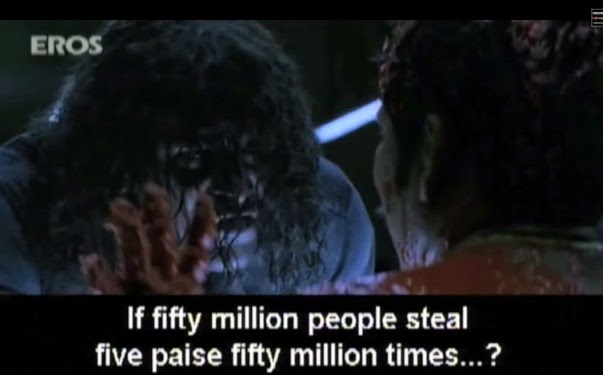
Is it the act of crime or the value of such crime, which should be focal point ? The ‘Anniyan’ dialogue is certainly one to ponder – the general reaction to ‘5 paisa thirudina thappa’ – is that the amount is negligible but when ‘5 kodi per 5 thadava 5 paisa thirudina’ ?   Here is what the Apex Court of the Nation had to say in a Civil Appeal between an individual and Life Insurance Corporation of India decreed in Jan 2015. 

The case pertains to the appeal against  judgment and  order  dated  27.8.2009, passed by the High Court of Judicature at Allahabad, whereby  said  Court  has  partly  allowed  the  appeal,  and substituted  the  punishment  of  removal  awarded  to  the  appellant,   by compulsory retirement from service.

The facts of the case, in brief, are that the appellant was  a  cashier  with  LIC working in an Office in UP.  A Policy holder deposited an amount of Rs.533/- towards half yearly insurance premium in Aug 1990 -  the same was not deposited in LIC till Nov 1990, though a receipt was issued on 13.8.90 by the appellant.  It appears  that when the LIC agent did not get his commission for this particular payment, the amount of Rs.533/-  was  shown deposited by the appellant with late fee of Rs.15.90/-, and entry  was  made in the cash register on 28.11.1990. Also, a forged entry was made in  ledger sheet on back date. 

In connection with the above misconduct, a charge sheet was served on the employee in Apr 1991 on the counts of  temporary embezzlement of  Rs.533/-  for a short period and  forging entry of Rs.533/- in the carbon copy of  the  ledger sheet dated 13.8.1990 between entry Nos. 12 and 13.  On  conclusion  of  the departmental enquiry, the appellant was found guilty, and served  with  copy of enquiry report, whereafter he was removed from service in Jan 1992.  The departmental appeal too was dismissed.  Challenging the order of removal from service  and  that  of  the  appellate authority, the appellant filed  writ petition before the High Court in Sept 1999.  Aggrieved by order of the learned Single  Judge,  Special Appeal was filed before Division Bench of the High Court,  by   LIC.

 The Division Bench, after hearing  the  parties,  came  to the conclusion that the appellant appears to have committed the  forgery  to cover his mistake, and partly allowed the appeal by substituting  punishment of compulsory retirement in place of removal from service.   The  appellant-employee has challenged the order of the Division Bench of  the  High  Court by way of SLP mainly on the ground  that  the  punishment of compulsory retirement is disproportionate, unreasonable and harsh. 

Attention of the Court was drawn to Rule 23 of  Life  Insurance  Corporation  of  India  (Employees)  Pension Rules, 1995, which reads as under:-
"23. Forfeiture of  service.  -  Resignation  or  dismissal  or  removal  or termination or compulsory retirement of an employee from the service of  theCorporation  shall  entail  forfeiture  of  his  entire  past  service   andconsequently shall not qualify for pensionary benefits."  - it was argued on behalf of the appellant that it being a case of temporary embezzlement of a small amount, as such awarding minor  punishment of stoppage of increment etc. would have met the ends  of  justice.   It was also sought to be portrayed that the amount could not be credited as the cash paid by policy holder was short !

It did not hold water and Court held that they did not find the punishment to be harsh or disproportionate to the guilt,   in  view  of  the nature of the charge of which the appellant is found guilty.   The Court opined that time and again the Court  has consistently held that in such  matters no sympathy should be shown by the Courts.  Reference was drawn to - Divisional Controller, N.E.K.R.T.C v.  M.  Amaresh,    where the Court held that :
" In the instant case, the misappropriation of the funds by  the  delinquent employee was only Rs 360.95. This Court has considered the  punishment  that may be awarded to the delinquent employees who misappropriated the funds  of the Corporation and the factors to be considered. This Court in a catena  of judgments held that the loss of confidence is the  primary  factor  and  not the amount of money misappropriated and  that  the  sympathy  or  generosity cannot be a factor which is impermissible in law.”

When an employee is  found guilty of pilferage or of misappropriating the  Corporation's  funds,  there is nothing wrong in the Corporation losing confidence or faith  in  such  an employee and awarding punishment of dismissal. In such cases,  there  is  no place for generosity or misplaced sympathy  on  the  part  of  the  judicial forums    and    interfering    therefore    with     the     quantum     of punishment........".

In another case of KSRTC, the unaccounted money was only Rs.93/- - there too, the Court held that  " Coming to the question of quantum of punishment, one should bear  in  mind the fact that it is not the amount of money misappropriated that  becomes  a primary factor for awarding punishment; on the contrary, it is the  loss  of confidence which is the primary factor to be taken  into  consideration.” In another case of Rajasthan State Road Transport Corporation, the Court opined that in  cases  involving corruption there cannot be any other  punishment  than  dismissal. 

The Court held that any sympathy shown in such cases is totally  uncalled for and opposed to public  interest.   The  amount  misappropriated  may  be small or large; it is the act of  misappropriation  that  is  relevant.   In the instant case, the Hon’ble Court held that they are not inclined to interfere with  the  impugned  order passed by the High Court and accordingly dismissed the appeal, with no order to costs.

With regards – S. Sampathkumar

17th Feb 2015.  

when Yajuvindra Singh caught his way to glory !!

Indians have not exactly been great fielders barring elite few. At Adelaide, featuring in that grand win,  Virat  Kohli made a century – the first in Indo Pak encounters in World Cup.  With this Kohli has 22 - only behind Sachin Tendulkar (49); Ricky Ponting (30); Sanath Jayasuriya (28) and Sourav Ganguly (22) – Kohli is the quickest making them in just 151 innings ! Including Kohli, there are 3 Indians in that elite test.  Youngsters may never understand that the first ever century by an Indian in ODI came in 1983, a good 9 years after India played its first ODI and for long there were only a handful centuries made by Indians.

Sachin rewrote many of those records ….. there have been record breaking performances by Indians in batting and bowling.  Indians, are not known to be any great fielding team, though there have been individuals like Eknath Solkar, Abid Ali, S Venkatraghavan, Brijesh Patel – who excelled in those days.  In the present team also, S Dhawan, Virat Kohli, Ajinkya Rahane, Suresh Raina excel.  This is about a man who played only 4 tests, yet is a joint holder of two World records – and it was achieved in his debut test Yajuvindra Singa got an opportunity to play  England at Bangalore in 1976-77 to strengthen the middle-order batting; he opened the bowling too.  In the first innings, he took five catches to equal the record held by Australia's Vic Richardson against South Africa in 1935-36. In the second he held two more and this saw him equal the record held by Richardson's grandson Greg Chappell who took seven catches against England in 1974-75.

it is VVS Laxman here

Years later, Greg Chappel invited him to give the Indian team a quick lesson on close-in catching. Singh spent almost an hour with the Indian fielders in the middle, explaining to them the nuances of fielding at close-in positions.  ''One shouldn't be scared and remember that close-in fielding is not just about catching but stopping singles too,'' he said. It was the time when England Tony-Greig-led squad  toured India in 1976-77 ; Greig was fortunate to have a well-balanced side of batsmen, bowlers and all-rounders.  England won the first three Tests ¬ the first side to accomplish that feat on a tour of this country - and, although India came back in the five-match rubber, the final margin of 3-1 was somewhat flattering to the visitors, in a series marred by Vaseline incident with John Lever being the central player.

It was Test no. 794, the 4th test of that Series played at Bangalore on 28th Jan 1977.  India batting first, meandered to 205/6 on day 1.  Anshuman Gaekwad (39), Surinder Amarnath (63) and Kirmani (52) contributed.  Debutant Yajuvindra Singh was out for 8.  Indians were bowled out for 253 in 85 overs.  The big burly Bob Willis took 6 wickets for 53.  England surprisingly were bowled out for 195 in 96.2 overs.  Bhagwat Chandrasekhar had figures of 32.2-7-76-6 while Prasanna took 3 for 47.  Dennis Amiss made 82. Yajuvindra Singh, the debutant took 5 catches.  The scorecard read :
DL Amiss  C Yajuvindra b Chandra 82
KWR Fletcher C Yajuvindra b Prasanna 10
Derek Randall C Yajuvindra b Prasanna 10
Tony Greig* C Yajuvindra b Chandra 2
Derek Underwood C Yajuvindra b Chandra 12
India in their 2nd innings declared (yes !!) at 259/9.  Gavaskar made 50; GR Viswanath made 79. Derek Underwood took 4 wickets. 

Chasing an improbable 318, England were all out for 177 losing by 14o runs – a big margin.  In the 2nd Bishan Singh Bedi had figures of 21.3-4-71-6.  He opened the attack with Karsan Ghavri.  Chandra took 3 for 55.  Ghavri bowled only 4 overs to have 4-1-4-1.  Yajuvindra  opened the attack in the 1st innings and bowled a solitary over.         

In the 2nd Singh, took 2 catches – sending out Amiss off Ghavri and Fletcher off Chandrasekhar. Besides the good bowling of Indian spinners, the catching of Yajuvindra Singh, who equalled the World record stood out.   India after a rest day, declared at tea on the fourth day with an overall lead of 317.  At the end of the fourth day, England were 34 for four, the wickets having gone down  when the total was mere 8. 

Yajuvindra’s career however faded away – he played 3 more tests.  In that Oval Test in Aug 1979 (when Venkat was unceremoniously sacked)  when India made an epic chase and Gavaskar made 221, he made 43* in first innings.  He returned to play the Chepauk Test no. 855 against visiting Aussies led by Kim Hughes.  He made 109 runs in 7 innings. 

The highest catches (7)  held in a Test is jointly shared by Greg Chappell, Yajuvindra singh, Hashan Tilakaratne, Stephen Fleming and Mathew Hayden.  Most catches in an innings (5) is jointly held by VY Richardson, Yajuvindra Singh, Azharuddin, Krish Srikkanth, Stephen Fleming, Greame Smith, D Sammy and DM Bravo. 

With regards – S. Sampathkumar

17th Feb 2015.

Monday, February 16, 2015

World's costliest iPhone !!

Do you carry a phone or a fashion statement ! ~ are you the passionate about technology or old-fashioned who think that ‘phone’ is an instrument is to receive / make calls !! ~  youngsters are attracted go gadgets that have speed, variety and attraction.  Some find their lives addicted to smartphones that have advanced operating system capable of doing many works and  could have a personal digital assistant, media player and GPS navigation unit. Most have a touchscreen interface and can run 3rd-party apps, and are camera phones with hi speed web browsing, Wi-Fi, motion sensors and mobile payment mechanisms.

‘iPhone’  is a line of smartphones designed and marketed by Apple Inc. It runs Apple's iOS mobile operating system. The first generation iPhone was released in 2007; the most recent iPhone models are the iPhone 6 and iPhone 6 Plus, which were unveiled at a special event in Sept 2014. iPhone costs approx something over Rs.50000 approx.  The user interface is built around the device's multi-touch screen, including a virtual keyboard. The iPhone has Wi-Fi and can connect to many cellular networks.  An iPhone can shoot video,  take photos, play music, send and receive email, browse the web, send texts, GPS navigation, record notes, do mathematical calculations, and receive visual voicemail.  There are eight generations of iPhone models, each accompanied by one of the eight major releases of iOS.

If you ever felt that the price of iPhone is too high, then perhaps this post is not for you ! … it is about the  World's most expensive iPhone 6 on sale which at £2.3million designer boasts 'it's worth as much as a small island'.  The Indian Rupee equivalent would be approx 22 Crores….  It is not a phone available over the net or on a famous shop – it is a personalised gadget.  MailOnline reports that the  World's most expensive iPhone 6 has been unveiled and not only is it made of 24-carat gold, it is encrusted with dozens of tiny diamonds.  If you dream of snapping up the exclusive design, you'll need a spare £2.3million ($3.51million).

The company behind the outrageous design, which sees the Apple logo made up of diamonds as well as lining the side of the device with the precious jewels, is called Goldgenie. It reportedly counts Usain Bolt, former football star David Beckham and rapper and music producer P Diddy among its clients. Founder Laban Roomes said: 'This is probably the most exclusive phone at this time, date in the world, I would say it as worth as much as a small island.'

The 'Diamond Ecstasy iPhone' can be customised further to meet client's wishes, with a choice of gold, platinum or rose-gold finishes as well as personally chosen diamonds or other gemstones. The Apple logo is made up of diamonds as well as the side of the device being lined with precious jewels.

But if you can't afford to splash out on the diamond edition, Goldgenie offers personalised phones starting from £9,700 (Rs.9,32,000/- approx). It is not the first time a company has offered an outrageously expensive iPhone for sale. Last year designer Alexander Amosu created a gold iPhone 6 covered in 6,127 diamonds for an anonymous client. A solid gold Apple logo was also fixed to the back and whole handset cost the customer £1.7million ($2.62million)

With regards – S. Sampathkumar

16th Feb 2015.