Search This Blog

Wednesday, December 20, 2017

Navdeep Saini's INA connection ~ Ranji update !!

It cannot get bigger than this is the common refrain – but IPL keeps growing the 2018 IPL auction will be held on January 27 and 28, in Bangalore. The mega auction will coincide with the final two days of India's third Test on the tour of South Africa; Virat Kohli's team is scheduled to play the final Test of the South Africa tour from January 24-28 in Johannesburg.  It is read that IPL has asked all eight franchises to submit their final list of retained players by January 4. The IPL is likely to finalise the pool of players who will be up for auction around January 18.
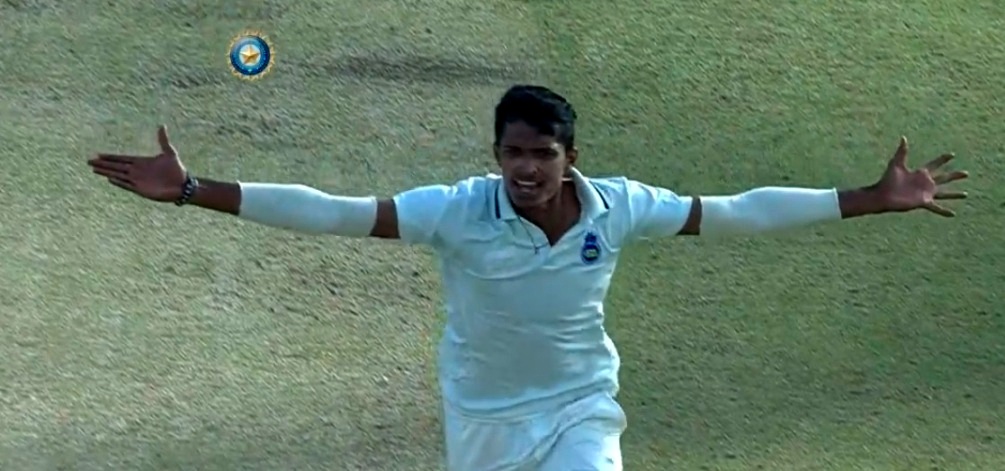
Not many would have noticed him when Delhi Daredevils bought him for 10 lakhs – but many heads turned when Navdeep Saini managed to do what not many fast bowlers around the world can't: bounce-out David Warner.  In a tour match, the  Australian opener was sailing like he usually does at the top of the innings, racing to 25 in just 30 balls; the   two experienced India 'A' new ball bowlers – Ashoke Dinda and Hardik Pandya – were unable to trouble the left-hander even a little bit. But in the ninth over the day, Pandya threw the ball to a rather unheralded Saini. In just the fourth ball of his spell, the right-arm pacer banged one in at short of a length. It grew bigger on Warner than he would've expected, and the Australian top-edged the ball straight up in the air to wicketkeeper Ishan Kishan.

Indian history perhaps is to be taught far differently than what we read in history books as Gandhi winning freedom without spilling blood – that defies rightful place for many great freedom fighters who sacrificed their lives in pursuit of freedom for the Nation.  The Indian National Army (INA) was originally founded by Capt Mohan Singh in Singapore in September 1942 with Japan's Indian POWs . At the urging of their Japanese captors, almost 20,000 Indian prisoners-of-war had come together to form this army with the aim of freeing India from British colonial rule. Under the charismatic leadership of Subhas Chandra Bose, who led the INA from July 1943 until his sudden death in August 1945, the INA grew in strength and received significant support from the civilian Indian population in Malaya. After World War II, the British charged some of the captured INA soldiers with treason.

While the whole nation was engaged in the August movement, the struggle for independence was carried on by Subhash Chandra Bose outside the frontiers of India. Subhash Chandra Bose joined the non-cooperation Movement but was not satisfied with the principle of non-violence of Gandhiji and supported Motilal and C.R. Das in the venture of organising the Swarajist party. Subhash was appointed the Chief Executive officer of Calcutta by C.R. Das, the Mayore of Calcutta. The progressive activities of Subhash invited the displeasure of the Government and were deported to Mandalay. Subhash represented the young and extremist elements in the Congress. He was elected as the President of the Congress in 1938 and again in 1939. He could not make any compromise with Gandhi and thus resigned his President-ship and organized the famous Forward Block. In a romantic and daring journey changing names and looking different he proceeded from there to Moscow and finally reached Berlin in March 1941. Rash Behari Bose convened two conferences one at Tokyo in March, 1942 and the second in Bangkok in Jun 1942. The revolutionaries assembled in the conferences decided to form an Indian National Army (Azad Hind Fauz) for the liberation of India from the British rule. In February 1943, Subhash left Germany from Kiel port in a Submarine. Through risk, suffering and untold hardship he finally reached Tokyo in June 1943. He held discussion with the Japanese authorities in the course of which the latter promised the independence of India after the war. From Tokyo he went to Singapore where he was warmly welcomed by Rash Behari and the latter handed over the leadership to Subhash.

For those of us following Ranji, it was a debacle as in  Nov 2017  Tamil Nadu ended it's campaign in this year's Ranji Trophy tournament by losing its final Group "C" match to Baroda by 102 runs. Requiring 233 for a win, the visiting team was all out for 130 in 65.5 overs.  TN finished poor in their Group "C": 1. Madhya Pradesh 21 points (qualified); 2.Mumbai 21 points (qualified); 3. Andhra Pradesh 19 points; 4. Baroda 16 points; 5. Tamil Nadu 11 points; 6. Odisha 6 points; 7. Tripura 4 points.

Other teams played grittily – there would be not much of a fight when the team is three down and trailing significantly in the second innings. On Tuesday in the 2017-18 Ranji Trophy, both semifinals had reached similar junctures. In Pune, Bengal had conceded a first-innings lead of 112 and lost their top three while still trailing by 77. In Kolkata, Vidarbha were 54 behind when they lost their top three. But from there, both teams took entirely different routes.

Bengal crumbled to 86 all out, as Delhi stormed into the final with victory by an innings and 26 runs. Vidarbha, on the other hand, lost just one more wicket, and scrapped hard to remain in contention for their maiden Ranji final. By the time play had wound down at Eden Gardens, Vidarbha had moved into a 79-run lead - marginal but enough to keep their dream alive.  Wasim Jaffar plays for Vidarbha now. 

On a day when fast bowlers on both the sides produced game-altering spells, it was Bengal's freefall with the bat that had them plummet to a defeat by an innings and 26 runs in Pune. After Mohammed Shami's 6 for 122 limited Delhi's lead to 112 runs, Delhi's bowlers shot the opposition out for 86 within 25 overs to book their team's spot in the final. Bengal's batting line-up was spliced open by Navdeep Saini and Kulwant Khejroliya, who relied as much on their red-hot pace as the batsmen's muddled thinking as they helped themselves to four wickets each. All of Saini's dismissals - Sudip Chatterjee, captain Manoj Tiwary, Aamir Gani and B Amit - were bowled. Saini knocked over Gani and Amit off successive deliveries that registered speeds of 140 kph and 144 kph respectively. He finished with seven wickets in the match.

With 29 wickets from seven games, Saini has been Delhi's second-highest wicket-taker so far this season, behind left-arm spinner Vikas Mishra. But, blockbuster showing in Ranji Trophy 2017-18 aside, he has been getting the attention of the national selectors for some time now, mainly for his ability to bowl at a sharp pace consistently. He provided a demonstration of that by frequently clocking speeds upwards of 140 kph in the semi-final - two such thunderbolts accounted for Aamir Gani and B Amit off successive deliveries.

Back home, one of Saini's biggest supporters is his "100-plus-year-old" grandfather Karam Singh, a war veteran whom he says had fought in Subhash Chandra Bose's Indian National Army (INA). "He used to be a driver in the INA," Saini said. "He is still remarkably fit and even rides a bicycle. He doesn't understand any cricket, but derives a lot of pleasure watching me play on TV. I am sure he would have been watching this game as well."

Interesting and all the best Saini !

With regards – S. Sampathkumar

20th Dec 2017.

Tuesday, December 19, 2017

caring for flora and fauna ~ ethnic cleansing and fitting spikes to trees to protect cars

In Cinema and in story books, we have read about some being so calm, peace-loving, caring for humanity and doing lot for promoting peace ? is all that true – or are humans cruel ? to fellow humans and more to the flora and fauna around them.

In the modern developed World, there are so many selling arms and in places, people engaged in ethnic cleansing? Do they fail to recognise the inherent humanity of their victims, or do their acts represent an excess of morality, morality that can be satisfied only by punishing a fellow human? What’s the motive that spurs on this violence?  And before you fall victim to those propagating peace, do not fail to see their ulterior motive of proselytization !  There is also much talk about killer robots that can attack without a human operator ! there are many theories and stories about these  dangerous tools. Such  autonomous weapons ‘can be weapons of terror, weapons that despots and terrorists use against innocent populations, and weapons [that can be] hacked to behave in undesirable ways’.

History reveals many ugly sides too – there were those European wars of religion, a series of savage religious wars waged in Central, Western and Northern Europe from 1524 to 1648 following the onset of the Protestant Reformation in Europe. The wars were strongly influenced by the religious change of the period and the conflict and rivalry that it produced. Nevertheless, the combatants cannot be neatly categorised by religion, nor were they divided by religion alone, and in most cases religion was only a part of the causes of the wars.

~ and in this beautiful World, there are some to whom animals (be it small pets, birds and more) are passion of their life.  They love, live with them and laugh with them. Back home, landscape of Shekhawati region is dotted with khejri (Prosopis cineraria) trees, which can survive in the worst of the droughts and are an important source of fodder for camel and goats.  Banni tree, considered a symbol of courage, peace and prosperity, is the State Tree of Rajasthan and newly formed Telangana. The bark of vanni  tree is useful in treating piles, worm infestation, muscular and joint pains. Used as antidote for snake or scorpion-bite poisoning. Paste of flowers with sugar is given to prevent unexpected abortions. The leaves and fruits are used to cure nervous disorders. The smoke by burning leaves exposed in case of eye complaints.

In 1730 AD, a small village located 26 km south-east of Jodhpur in Rajasthan witnessed probably the first and most fierce environment protection movement in the history of the country. Amrita Devi of Khejarli village and her three young daughters laid down their lives to protect the sacred trees which the ruler of Marwar Maharaja Abhay Singh had ordered to be cut down for building his new palace. This inspired other members of the community and a total of 363 people sacrificed their lives in coming days trying to save the trees by hugging them while the king’s men chopped their bodies with axes. The ‘martyrs’ belonged to Bishnoi community and the trees which they were protecting were ‘Khejri’. In 1970s, this sacrifice became the inspiration behind the Chipko Movement. .. .. .. now you may be saddened reading this real incident in UK, reported in MailOnline.

In a particular area, people had expensive cars that were parked outside their houses and every morning they found them cluttered with bird droppings – humans being intelligent, thought that over and came with novel method of prevention that of fitting trees with 'anti-bird spikes' to stop pigeons relieving themselves on their vehicles. The spikes - normally used to stop birds settling on buildings - have been nailed to two beech trees in an exclusive suburb of Bristol. Several lower-hanging branches in the grounds of Essendene House and Heathfield House, near the city's famous Downs grasslands, have been fitted with the contraption.  They were fixed to branches overhanging a car park where numerous BMWs and Audis are parked to deter the creatures from defecating on their pricey cars.  The lethal-looking spikes have been criticised by environmentalists who claim the contraption makes it impossible for birds to rest or build nests in the trees.

A representative of Green Party is quoted as saying : 'I'm aware that the landowner might be legally within their rights to do this to the trees as they seem to be on private land. However, it does look bad and bad against birds.  'Whether allowed or not though, it looks awful and it's a shame to see trees being literally made uninhabitable to birds - presumably for the sake of car parking.

'Sometimes it's too easy to lose sight of the benefit that we all gain from trees and green spaces and from the presence of wildlife around us in the city.' One of those owner was clear that they had tried out things including keeping a wooden bird, but nothing worked and hence they decided that birds should not be sitting on trees under which they park their expensive cars – after all cars are more needed than the birds.

One tweeted it as a 'war on wildlife'.  Writing furiously : 'Now birds are not allowed in trees...?!'

With regards – S. Sampathkumar

19th Dec 2017

Sunday, December 17, 2017

Swami Vivekananda's Madras connection ~ and the photographer who framed him here

Those days, when one travelled by Pallavan Transport Corporation,  people were used to hearing the conductor shout the place by identifying the nearest landmarks – at this place, they would tell the passengers -   ‘icose’…. ‘aicose’  ~  it was that derivative of Ice House !! It was in fact a more iconic landmark – more than a century and few decades more – where ice was stored.  In 1833, a merchant of Boston, Fredric Tutor built houses for storing ice.  He reportedly bought ice to India in merchant ships, stored them in well like structures with charcoal as protection and supplied them to Britishers. 


Narendra Nath Datta  later to be hailed as Swami Vivekananda, in his monastic life as, was born in an affluent family in Kolkata on 12 January 1863. His father, Vishwanath Datta, was a successful attorney with interests in a wide range of subjects, and his mother, Bhuvaneshwari Devi, was endowed with deep devotion, strong character and other qualities. A precocious boy, Narendra excelled in music, gymnastics and studies. On September 11, 1893, the Parliament opened. On the first day itself, after four other prepared speeches were read, Swamiji was asked to speak. In one of the greatest orations, he started with ‘Sisters and Brothers of America’ – five immortal words that made the 7000 strong audience to stand up in the realization they were witnessing an epochal moment. The speech was very brief, but, so brilliant was he that overnight he became a sensation.

The greatness of Swami Vivekananda has many books written on him ~ this is limited to his memorial at Triplicane and some Triplicane connection of his.  Way back in 1890s, a person by name Alasinga  heard about ‘Parliament of World Religions’ to be held in Chicago in 1893. He being a well learned person,  could have gone to the Parliament himself, but, given his modesty, he wanted someone else more scholarly to go. By some description, MC Alasinga Perumal  is stated to be the headmaster of the High School attached to Pacheyappa's College. From the time when the Swami first came to Madras in December 1892 after his visit to Kanyakumari and Rameswaram, he attached himself with adoring love and never-failing enthusiasm to the Swami's person and to his ministry in the world in all its phases and details — an adhesion and service to the Great Master Vivekananda.

In Madras, Alasinga initially just organised Vivekananda’s lectures and he understood that Swamiji was the person to go to Chicago. He ensured collection of required resources for the trip and he himself carried  Swami Vivekananda’s luggage on to the ship , ‘Peninsular’, in Bombay bound for the America and saw him off.

Panoramic view of the Stately Vivekananda House, Triplicane

When Swamiji returned to Chennai in 1897 he was taken on a procession to Castle Kernan owned by Biligiri Iyengar (the same icehouse that had changed hands to a leading advocate in Madras).  During his nine day stay, he shook India’s national consciousness through his fiery lectures at Chennai. Later, Ramakrishna Math (Monastery) Chennai was founded by Swami Ramakrishnananda, a brother disciple of Swami Vivekananda. The Math functioned from here during its first 10 years (1897-1906) until it got moved to the current location at Mylapore, Chennai. In 1963, during the Birth Centenary of Swami Vivekananda, the Government of Tamil Nadu renamed the Castle Kernan as Vivekanandar Illam.  Vivekananda House now houses a Permanent Exhibition on Indian Culture and Swamiji’s Life, maintained by the Ramakrishna Math and is a source of inspiration to thousands of people who visit it every year.
Swami Vivekananda at Triplicane  1897 (pic wiki commons)

The museum houses some relics, showcases the room where he stayed and some rare photos of Swami Vivekananda including those taken during his stay in Madras, at Kanyakumari, Ceylon and elsewhere.  Some of them and more specifically a phototype of Swami in simple sanyasin dress  that appeared in Apr 1897   issue of Prabuddha Bharata has the credit line of one  T. G. Appavan Mudaliar, with address of  No. 3, Veeraraghava Mudali Street, Triplicane, Madras.. ..  those of us in Triplicane know that Veeraraghava Mudali Street, is the famous Big Street that has Hindu High School. Appavan Mudaliar is stated to be a reputed photographer of his time, residing in Triplicane.  Ramakrishna mission web states that the Chennai math researched in finding more on this photographer but could not locate the house or descendants of him.

Though I am born and brought up in Triplicane, for the first time visited the museum at Vivekanadar Illam today  and am thoroughly impressed.  One grievance is though it houses lot of good photos, photography is banned here.

With regards – S. Sampathkumar

16th Dec 2017.

Saturday, December 16, 2017

the intelligent Brydon Coverdale ! - Cricket writer and Quizzer ..

Often tourists would be confronted and bowled over in a pacy wicket at Perth – in Nov 1981, the Aussies batting first were bowled out for 180 but struck back strongly dismissing Pakis for 62 – Dennis Lillee, the menace had figures of 9-3-18-5 while Terry Alderman took 4/36.  Australia went on to win that match by 286 runs. 
Every heard of - Ichthyology – do you know what is that associated with it ? ;  There is a blog ‘DadREads’ on what the person reads to tell his children – and one post goes  : other day I was flicking through Richard Scarry's Busiest Fire Fighters Ever, a Little Golden Book from the early 90s. And I noticed that these frightened looking pigs seem to be under attack from giant pieces of bacon. And one of the pigs is named Smokey. .. .. .. ..

‘Naan ready – Neenga Readiya ?” – was the poser to audience by Sarathkumar…. many years ago !  Do you remember the show “Koteeswaran” featuring the actor in Sun TV on the lines of ‘Kaun Banega Crorepathi’ ?  Koteeswaran is common name – a Hindu name after Lord Easwar; one denoting unlimited riches.  ‘koti’ is crore and the one named so is blessed to possess crores of values… way back in 1955 there was a Sivaji Ganesan / Padmini starrer produced by Sri Ganesh Movietone with background score by G Ramanathan.  KBC itself was made after – who wants to be a Millionaire

Who Wants to Be a Millionaire?  Was aired in Australia too – the  game show offered a maximum cash prize of $1,000,000 for answering 15 successive multiple-choice questions of increasing difficulty as a team. The show was based on and followed the same general format of the original version of the show from the United Kingdom, and is part of the international Who Wants to Be a Millionaire?

Today at WACA, Australia ended the day at 549/4 with Steve Smith 229*, M Marsh 181* going great guns giving a lead of 146 runs.  Brydon Coverdale covering the match for ESPN writes :   It would be hard to imagine a day of greater Australian dominance than this one. It was a day on which Steven Smith made his second Test double-century, Mitchell Marsh scored his maiden Test hundred, England claimed just a single wicket and Australia piled on 346 runs. A day that began with Australia trailing by 200 finished with them 146 runs in front, and with a realistic chance of pushing for victory - and the urn - over the next two days. Remind us why Australia would want to move Ashes Tests away from the WACA?
pic credit : guardian.co.uk

But a caveat is necessary, for it was not a day that necessarily ended England's campaign. The pitch remains good for batting - that is stating the obvious - and there is rain forecast over the next two days in Perth. It remains very possible that England will escape from this match with a draw, and as the holders of the Ashes, that would keep them alive in the series. Alive, but demoralised. They might have known that Smith could score a mountain of runs, but Mitchell Marsh eyeing off a Test double-century by stumps? They'd have been more likely to expect the Spanish Inquisition. This was a day that can best be illustrated by the numbers, and at the close of play, the numbers were these: Smith was on 229, Marsh was on 181, and Australia had 4 for 549. Hundreds were also piling up in England's bowling analysis: Craig Overton, Chris Woakes, Stuart Broad and Moeen Ali had all conceded centuries by the close of play, and if James Anderson - currently at 0 for 85 - joins them on the fourth day, it will be just the eighth time in Test history that a team has had five or more bowlers concede 100 in the same innings.

The man at the start,  writer - Brydon Coverdale is an Australian quiz personality best known for being one of the "Chasers" on The Chase Australia, where he is nicknamed "The Shark".   Prior to The Chase Australia, Coverdale appeared on several other Australian quiz programs, including, Million Dollar Minute, where he won $307,000 in 2014. He became the first grand champion of Pass the Buck where he won $38,788 in 2002. He also won a total of $32,000 on Who Wants to Be a Millionaire?,  and appeared in many other Quiz shows.  Coverdale is a reporter and assistant editor at ESPNcricinfo, a news website exclusively for cricket.  Coverdale is married to  Zoe in Eltham, and they have a daughter named Heidi. Coverdale also runs a blog named DadReads, discussing children's books he has read to his daughter.

The Cricket writer Brydon Coverdale  scored himself $307,000 on the Channel 7 quiz show Million Dollar Minute. In 2014, on that day, with  just two seconds left on the clock the Victorian local fluked the last question to take home the biggest cash payday in the history of afternoon game shows on Australian TV. “I really did not know the answer so I went with my gut feeling,” he said. “My wife Zoe is going to be speechless…I think I owe it to her to take her on a second honeymoon - a luxury tropical holiday.”

Inquisitive to know what the 5 Questions were ?  : Final 5 questions:
1.         Ichthyology is the study of what?
Ichthyology also known as fish science, is the branch of zoology devoted to the study of fish. This includes bony fish (Osteichthyes), cartilaginous fish (Chondrichthyes), and jawless fish (Agnatha).
2. In what year was the GST introduced?  (in Australia in 2000)
3. Which Olympic sport has provided Australia with the most gold medals? (Swimming)
4. Mickey Rourke was critically acclaimed for which 2008 movie? (The Wrestler)
5. On what part of the body do you wear espadrilles? (Feet)

Interesting !!

With regards – S. Sampathkumar

16th Dec 2017.